Using Mixed Media, Sculpture and Photography with a Painting Project
Last Updated on February 8, 2017
Sometimes I notice Art projects that hold tremendous value as learning tools for students and teachers. This is one such project. Completed by Bronte Heron, while studying Fine art in Year 12 at New Plymouth Girls' High, this NCEA Level three Painting folio (the equivalent of A2 Fine art & Design) was awarded an Excellence class with Scholarship (the highest upshot possible). Despite Bronte being a year younger than almost candidates, her piece of work was deemed one of the best art projects submitted by a New Zealand pupil in 2010 and is now part of the Top Art exhibition which tours New Zealand schools.


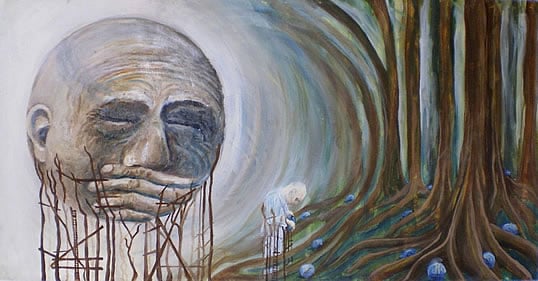
In an exciting cross-bailiwick fashion, Bronte's portfolio is filled with rich, mixed media pieces that morph seamlessly from i medium to next: textural drawings, sculptural installations, photography, manipulated photographs and beautiful paintings all feed from one to the other and aid the intelligent exploration of ideas. Comprising of creative, surrealist compositions that are woven together from fragments of real life images, Bronte's A1 Art boards are bear witness of a superb approach to a 'fantasy' topic. The highly imaginative pieces are derived from initial observation of trees, the human figure, scaffolding and other forms and develop in an original direction with reference to artist models.
I was lucky enough to interview Bronte well-nigh her project:
Amiria: Your theme stemmed from a desire to express the demand for an elderly man to 'escape into his imagination' combined with a dear of drawing elderly faces. Was information technology difficult to come up with the theme: 'When he lost his marbles'? How long did it take for you to choose this theme and what fabricated you think of it?
Bronte: The thought of escaping into your imagination originally stemmed from Maurice Sendak'due south 'Where the Wild Things Are'. It'due south a children's book that has always been a favourite of mine, and I thought the idea of the principal graphic symbol, Max, inventing his own fantasy globe for entertainment when he was sent to his sleeping accommodation for bad behaviour was very interesting. In that location is one office of the volume in particular that really captured my interest; Max imagining his bedroom turning into a wood. The bedposts became tree trunks and the carpet became grass, etc etc. This play on an interior vs. an exterior landscape really defenseless my eye and the idea of someone being confined to a bedroom and creating an alternating reality to escape from their own isolation sprung up. My love of portraiture and fascination with wrinkles (absolutely an odd interest) influenced me to describe this character as an sometime homo. The confinement to a bedroom could and so be associated with dementia, immobility, or even a resistance to the ultimate finish (i.e. decease). Of course, creating another world that represented this old man's mental state meant that certain aspects of information technology had to be warped, such as scale and the laws of physics. This gives the impression of him being crazy, or losing his marbles. And so as you lot can see, the idea of an sometime homo losing his marbles developed over fourth dimension, I'd say it probably took me all of the first term of schoolhouse (about x weeks) to solidify this idea into something that could exist carried on throughout an entire portfolio.

Amiria: Please talk me through the subject field thing that you selected for this project (i.e. onetime man, marbles, tree trunks, wooden structures, ladders etc). For example, it would exist particularly helpful to know why yous selected each item and whether you had access to first-hand resource to draw from and how these things helped your works in terms of ideas and aesthetics?

Bronte: Using marbles equally a subject matter was a literal take on the metaphor of the old human 'losing his marbles'. How I used the marbles adult over the span of the portfolio. If you find that on the first board, the marbles are 'real'; they're small and the old man has command over them (for example he could hold them in his hands if he wanted to). This is supposed to symbolise that he has a grip on reality and is yet connected to the outside earth. On the second board, the series at the lesser prove a deterioration of sanity through the metaphor of marbles. In the get-go work, the quondam man is looking at his own reflection, symbolising a control over his sanity. The second work is of scaffolding that is warped past the shape of the marble, suggesting that it is collapsing (a metaphor that the quondam man's mental land has collapsed). In the tertiary work, the man is pressed confronting the inside of the marble, showing that he has gone insane and is trapped in the world he created for himself. The third board explores this metaphor with marbles in much the same manner, however the contrast between the old man's imagined world and reality is blurred, giving the impression that his imagination has become his reality. This relates dorsum to my interpretation of 'Where the Wild Things Are', discussed to a higher place.
The notion of using an interior vs. an outside landscape also influenced my choice of subject matter. Confinement to a bedroom immediately made me think of used, wrinkled sheets. I was as well really interested in using skeletal, gnarled copse and roots in my work, and I thought these represented an exterior mural well. Coincidentally, the wrinkles in the sheets, the grain of the tree trunks and the warped manner in which the roots grew mirrored the wrinkles in the skin of the old man, which tied the ideas together visually.
The scaffolding was an idea that was given to me past my Painting instructor, Ms Mercer. She thought that rickety, quondam bamboo scaffolding worked well with my theme considering not only was it wooden (therefore tying in with the natural shapes of the tree trunks and the roots), but it looks too flimsy to support weight, and is often tied together in odd ways, making it announced stacked and precarious. This introduced a whole new concept of stacking delicate elements, teetering on the edge, and somewhen losing remainder. We both agreed that this related back to the old human being losing his grip on the real globe. Using scaffolding also brought upward other points of involvement I worked with, such every bit suspension and weight being held up past frail supports.
I worked mostly using photographs, selecting sure aspects of images for different parts of a painting, meaning I used many photos to create one work. Unfortunately I lack the skill of being able to pigment without a photograph to guide me, so aye, I worked from photos whenever I could.
Amiria: Which artists did yous study every bit part of your project and how did these influence your piece of work?

Bronte: Egon Schiele was one of the first artist models I became interested in during the research for my portfolio. He painted a lot of disturbing and contorted figures, creating precipitous geometric angles with their outlines. One of his paintings was of greater involvement than his others; 'Gerti Schiele'. The biggest influence this had on me was the use of negative space. This was a pictorial result that I worked with almost constantly in my own paintings. The blank white groundwork in 'Gerti Schiele' unnerved me; it created a lack of depth and a lack of calibration. My interpretation of this was that information technology was similar to an abyss; countless nothingness. The negative space also emphasised the outline of the subject matter, and what I constitute actually interesting was that if you lot turn the painting on its side, the outline of the woman creates the silhouette of a landscape. The works I modelled most strongly on this painting are on the first board of my portfolio, in particular the middle work on the 2nd row (i.eastward. the geometric shapes created in the negative space, the lack of scale and the integration of interior and outside elements).
The houses and architecture Schiele painted (to a higher place) seem to be stacked on top of each other. This is a clever play on perspective that caught my eye, and I wanted to replicate this instability in some way. A belfry of objects piled precariously on top of one another was how I integrated this into my ain painting – this can be seen on lath ane, such equally the middle work on the second row. This idea developed into the sculptural installation that was one of my last works.

Another creative person I looked at used similar ideas to Schiele; Laura Owens. Once more there is a lack of scale and depth created through the use of negative space. The halved partitioning of space (used in the artwork to the left), rather than a harmonious rule of thirds, also adds an unnerving element to the painting, making the viewer experience as though they are intruding on an intimate moment. An interior landscape is also created by the outline of the pillow and the bed. I wanted to utilise this idea of an ambiguous landscape in my own mode, and used the bed sheets that are ever present in my piece of work to create what await like hills in paintings like the height ane on board two. Bed sheets were also part of the "landscape" I made for the sculpture installation on the final console, over again playing with the idea of interior vs. exterior.
Laura Owens likewise painted very dreamlike landscapes (like the i to the left). I was particularly interested in her trees, or rather tree trunks, and the flat backgrounds they were painted onto. Nearer the beginning of my page, I used copse/vines in conjunction with dream like elements, such as pillows, crowns and feathers, but every bit my work progressed I depicted them as being sucked into a vortex, bending and fading into white space. Owens' copse were an influence behind this, as they are organic and seem to respond to the environs effectually them.

I thought the way the artist Gerhard Richter used big white borders and smudges to make his piece of work seem grubby and discarded coincided with my ideas of the old homo feeling asunder from the 'real world' and non belonging in society. I incorporated his methods onto my second board in the first 2 rows of piece of work. The 'windows' in the first work were an interpretation of his borders and the third work in the second row is a more obvious interpretation of it.
Surrealism became an of import influence on me as my ideas progressed. Dali is an evident artist model of the third work in the second row of the first board; a drooping face supported past flimsy branches is reminiscent of one of his most famous works, 'Sleep'. The introduction of the little men climbing up and down tree trunks as if they were ropes and interacting with the bigger figure were derived from Dali's impossible ideas. This was a development in my own practise as I started painting original compositions that were influenced by Dali, every bit opposed to the recreation of 'Sleep' I painted on the outset board. The floating trees behind the figure I painted onto the bed canvas on lath two were besides derived from some of the nil gravity compositions of Dali'due south work.

M.C. Escher is another model I was influenced by. 'Hand with Reflecting Sphere' (above left) showed me how constructive warping a reflection could be, and taken into the context of my work, a warped reflection had real significance (craziness, an imagined earth, etc.). The series of the three warped reflections at the bottom of board two on my portfolio were variations on this work by Escher, the sphere taken into the context of a big marble. Escher connected to influence me onto board three. Similarly to the way I began to create original compositions every bit opposed to recreating paintings washed past Dali, my paintings started to reflect my own style rather than Escher's. The painted spheres in the installation (one of my final works) were inspired by Escher; the old human being seemingly trapped inside a marble (metaphorically trapped in his own globe) was a development of the old man'southward reflection in a marble.


Amiria: Your projection includes a sculptural component. What are the advantages of a Painting student working in sculpture to assistance develop their ideas?
Bronte: I think my ain work was always going to lean towards sculpture; right from the word go I was painting towers of objects and things hanging from string or scaffolding. It felt natural to make the transition. The reward of being able to make your works 3D is huge, because information technology opens upwards new means to develop and extend your methods and ideas. Being able to install your work in dissimilar contexts can change the significant of it, which in itself is a evolution. I took the painted-on bed sheet on the second board all over town and photographed it in different settings. These included a hotel that was beingness renovated and was full of edifice materials and half-finished repairs, my own bed, trees in parks and grungy alleyways. I could then edit out the installations that weren't and then successful and work into the ones that were. Using urban areas as installation sites had a very different effect to the studio installation I did on lath 3. The studio allowed me to draw attention to the subject matter rather than the surround.

Amiria: What advice do you accept for other high school art students who are hoping to achieve first-class grades?
Bronte: It's all almost making sure yous gear up enough fourth dimension aside to finish your artwork to a high standard. Art isn't a subject you tin can put off doing until the night earlier manus in. Working solidly throughout the year gives you enough time to go your art to take the result y'all desire information technology to requite. Also, get heaps of input from your teachers. Ms Mercer (my teacher) was dandy for lending her ideas and opinions, which helped me get a proficient course I think! Environment yourself with passionate people too. They volition proceed you enthusiastic about art and help you find new ways to extend yourself – this stops you from getting bored.
There is sometimes the perception that Art is an piece of cake subject…that those who do well are simply gifted with artistic knack. This commodity is a neat reminder that those who excel in Art are more than just adept with a pencil or castor: they are intelligent, committed, and driven students whose work is highly organised and communicates ideas with intention and clarity. The insight and level of understanding shown in Bronte'southward responses is refreshing – a reminder that it is only the all-time who truly soar.
If you wish to see more than examples of outstanding educatee artwork, please view our Featured Art Projects.

Amiria has been an Art & Design teacher and a Curriculum Co-ordinator for seven years, responsible for the course design and assessment of pupil piece of work in 2 high-achieving Auckland schools. She has a Bachelor of Architectural Studies, Bachelor of Compages (First Grade Honours) and a Graduate Diploma of Education. Amiria is a CIE Accredited Art & Blueprint Coursework Assessor.
Source: https://www.studentartguide.com/featured/mixed-media-painting-sculpture-photography
0 Response to "Using Mixed Media, Sculpture and Photography with a Painting Project"
Post a Comment