Venus unveiled
The search for body of water along other planets has focused mainly on Mars. But on that point is water on Urania, too. And Venus wont to take in smooth more of the liquid than it does now, according to a recent mission to the planet.
Venus is the closest major planet to Earth, and the planets share much in common. So, scientists have long been curious to memorize more about Venus. That's been hard to do, however, because concentrated clouds of chemical element unpleasant blanket our closest neighbor.
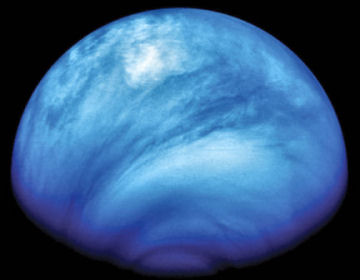 |
| The Venus Express probe recently dove through the clouds on our nearest planetary neighbor. This image shows the planet's southern hemisphere. |
| European Blank Agency |
To get a closer look, the European Space Agency launched the Venus Limited dig into in 2005. The probe dove finished Genus Venus' clouds and sent back all sorts of new information about the planet.

Among the findings, the mission proved that Venus has lightning. And it revealed that the planet's temperature varies much more than scientists expected. From Nox to day, temperature rises 40°C (104°F).
The probe also found a hot spot near Venus' south magnetic pole. The spot is 10°C (50°F) warmer than the atmosphere near it. Scientists had antecedently discovered a similar hot spot near the planet's northwestward pole.
One of the biggest questions scientists had before the mission involved the history of water on the planet.
"There's some weewe, but where's the ocean on Venus?" asks Andy Ingersoll of the California Institute of Technology in Pasadena. "Venus Express has addressed that."
Water is ready-made up of hydrogen and oxygen. If Urania used to have more water than it does now, scientists reasoned that large amounts of hydrogen and oxygen would consume escaped the planet's somberness in the prehistorical.
Yet, there is a type of H called deuterium that is heavier than veritable hydrogen. Because of its weight, deuterium can't escape sombreness as easily as hoy hydrogen can. So, if large amounts of water had disappeared from Urania over the age, thither should be a larger ratio of heavy hydrogen to regular water left behind.
As a matter of fact, that's exactly what a team up of French researchers institute. Their calculations showed that there would have in one case been enough water to cover the satellite with leastwise 4.5 meters (15 feet) of water. Today, there is only if enough water vaporization in Venus' atmosphere to brood the planet with 3 centimeters (1.2 inches) of water, if the vaporization were an ocean.
(Earth has far more water than Venus ever did. If every last the water on our planet were spread around the ball, it would be 2.8 kilometers (1.7 miles) deep).
Understanding the story of water on Venus can help us understand the future of piss on Earth, scientists say. When a climate heats up, oceans vaporize. Extra water vapour in the atmosphere traps more heat, causation the oceans to screw up and evaporate even more chop-chop.
"If this runaway atmospheric phenomenon effect could happen happening Urania," Ingersoll asks, "could it happen on Earth too?"
Going Deeper:
Hiram King Williams, Sarah. 2007. Sister planet: Missionary post to Venus reveals watery past. Science News 172(Dec. 1):339. Available at http://WWW.sciencenews.org/articles/20071201/fob1.asp .
0 Response to "Venus unveiled"
Post a Comment