What Did John D. Rockefeller Do to Establish Standard Oil as a Monopoly?
 | |
| Blazon |
|
|---|---|
| Industry | Oil and gas |
| Founded | Jan 10, 1870 (1870-01-10) |
| Founders |
|
| Defunct | Later its dissolution in 1911, the original Standard Oil Co. dissever into Sohio (now office of BP); ESSO (at present Exxon); and SOcal (now Chevron) |
| Successor | 34 successor entities |
| Headquarters |
|
| Central people |
|
| Products |
|
| Number of employees | threescore,000 (1909)[5] |
Standard Oil Co. was an American oil-producing, transporting, refining, and marketing company. Established in 1870 past John D. Rockefeller and Henry Flagler as a corporation in Ohio, it was the largest oil refiner in the earth at its tiptop.[six] Its history equally 1 of the world'due south first and largest multinational corporations ended in 1911, when the U.S. Supreme Court ruled that it was an illegal monopoly.
Standard Oil dominated the oil products market initially through horizontal integration in the refining sector, then, in later years vertical integration; the company was an innovator in the evolution of the business trust. The Standard Oil trust streamlined production and logistics, lowered costs, and undercut competitors. "Trust-busting" critics defendant it of using aggressive pricing to destroy competitors and class a monopoly that threatened other businesses.
Rockefeller ran the company as its chairman, until his retirement in 1897. He remained the major shareholder, and in 1911, with the dissolution of the trust into 34 smaller companies, Rockefeller became the richest person in modern history, as the initial income of these individual enterprises proved to be much bigger than that of a single larger company. Its successors such as Chevron, ExxonMobil, Amoco, and Marathon Petroleum, are still amidst the companies with the largest revenues in the world. By 1882, Rockefeller'due south top aide was John Dustin Archbold, whom he left in control after disengaging from business to concentrate on philanthropy after 1896. Other notable principals of the company include Henry Flagler, developer of the Florida East Declension Railway and resort cities, and Henry H. Rogers, who built the Virginian Railway.
Founding and early years [edit]

Standard Oil's pre-history began in 1863, as an Ohio partnership formed past industrialist John D. Rockefeller, his blood brother William Rockefeller, Henry Flagler, pharmacist Samuel Andrews, silent partner Stephen V. Harkness, and Oliver Burr Jennings, who had married the sister of William Rockefeller'southward wife. In 1870, Rockefeller abolished the partnership and incorporated Standard Oil in Ohio. Of the initial 10,000 shares, John D. Rockefeller received 2,667; Harkness received 1,334; William Rockefeller, Flagler, and Andrews received 1,333 each; Jennings received 1,000, and the firm of Rockefeller, Andrews & Flagler received i,000.[7] Rockefeller chose the "Standard Oil" name as a symbol of the reliable "standards" of quality and service that he envisioned for the nascent oil industry.[8]
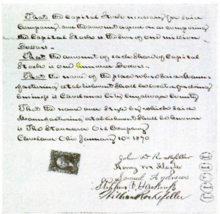
Standard Oil Articles of Incorporation signed past John D. Rockefeller, Henry Thousand. Flagler, Samuel Andrews, Stephen 5. Harkness, and William Rockefeller
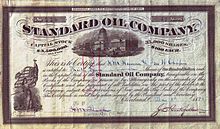
Share of the Standard Oil Visitor, issued May 1, 1878[nine]

Share of the Standard Oil Trust, issued January 18, 1883[nine]
In the early years, John D. Rockefeller dominated the combine; he was the unmarried near important figure in shaping the new oil industry.[10] He quickly distributed power and the tasks of policy formation to a system of committees, but e'er remained the largest shareholder. Authority was centralized in the company's main office in Cleveland, but decisions in the role were made cooperatively.[11]
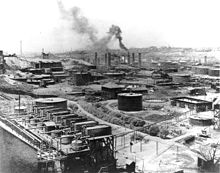
The company grew by increasing sales and through acquisitions. After purchasing competing firms, Rockefeller shut down those he believed to be inefficient and kept the others. In a seminal bargain, in 1868, the Lake Shore Railroad, a part of the New York Fundamental, gave Rockefeller's firm a going rate of 1 cent a gallon or forty-two cents a butt, an effective 71% discount from its listed rates in return for a promise to send at least 60 carloads of oil daily and to handle loading and unloading on its own.[ citation needed ] Smaller companies decried such deals every bit unfair because they were not producing enough oil to authorize for discounts.
Standard'due south actions and hole-and-corner[12] transport deals helped its kerosene price to drop from 58 to 26 cents from 1865 to 1870. Rockefeller used the Erie Culvert every bit a cheap alternative form of transportation—in the summer months when it was not frozen—to transport his refined oil from Cleveland to New York Urban center. In the wintertime months, his only options were the 3 trunk lines—the Erie Railroad and the New York Central Railroad to New York City, and the Pennsylvania Railroad to Pittsburgh and Philadelphia.[13] Competitors disliked the company's business practices, only consumers liked the lower prices. Standard Oil, being formed well before the discovery of the Spindletop oil field (in Texas, far from Standard Oil's base in the Midwest) and a demand for oil other than for heat and calorie-free, was well placed to control the growth of the oil business concern. The company was perceived to own and control all aspects of the trade.
S Improvement Company [edit]
In 1872, Rockefeller joined the Southward Improvement Co. which would take allowed him to receive rebates for shipping and drawbacks on oil his competitors shipped. But when this deal became known, competitors convinced the Pennsylvania Legislature to revoke South Comeback's charter. No oil was always shipped under this arrangement.[14] Using highly effective tactics, afterwards widely criticized, it absorbed or destroyed most of its contest in Cleveland in less than two months[ how? ] and later throughout the northeastern United States.
Hepburn Committee [edit]
A. Barton Hepburn was directed past the New York State Legislature in 1879, to investigate the railroads' practice of giving rebates to their largest clients within the state.[xv] Merchants without ties to the oil manufacture had pressed for the hearings. Prior to the commission's investigation, few knew of the size of Standard Oil'due south control and influence on seemingly unaffiliated oil refineries and pipelines—Hawke (1980) cites that but a dozen or and then inside Standard Oil knew the extent of company operations. The commission counsel, Simon Sterne, questioned representatives from the Erie Railroad and the New York Central Railroad and discovered that at to the lowest degree one-half of their long-haul traffic granted rebates and much of this traffic came from Standard Oil. The committee then shifted focus to Standard Oil's operations. John Dustin Archbold, as president of Acme Oil Company, denied that Elevation was associated with Standard Oil. He then admitted to being a director of Standard Oil. The committee'south final written report scolded the railroads for their rebate policies and cited Standard Oil equally an instance. This scolding was largely moot to Standard Oil'due south interests since long-altitude oil pipelines were now their preferred method of transportation.[xvi]
Standard Oil Trust [edit]
In response to state laws that had the result of limiting the scale of companies, Rockefeller and his associates developed innovative ways of organizing to effectively manage their fast-growing enterprise. On Jan 2, 1882,[17] they combined their disparate companies, spread across dozens of states, under a single group of trustees. By a secret agreement, the existing 37 stockholders conveyed their shares "in trust" to nine trustees:[18] John and William Rockefeller, Oliver H. Payne, Charles Pratt, Henry Flagler, John D. Archbold, William Thousand. Warden, Jabez Bostwick, and Benjamin Brewster.[19] "Whereas some state legislatures imposed special taxes on out-of-land corporations doing business in their states, other legislatures forbade corporations in their country from holding the stock of companies based elsewhere. (Legislators established such restrictions in the hope that they would force successful companies to contain—and thus pay taxes—in their state.)" [twenty] [21] Standard Oil's organizational concept proved and then successful that other giant enterprises adopted this "trust" form.
In 1885, Standard Oil of Ohio moved its headquarters from Cleveland to its permanent headquarters at 26 Broadway in New York City. Concurrently, the trustees of Standard Oil of Ohio chartered the Standard Oil Co. of New Jersey (SOCNJ) to take reward of New Bailiwick of jersey's more lenient corporate stock ownership laws.
Sherman Antitrust Act [edit]
In 1890, Congress overwhelmingly passed the Sherman Antitrust Act (Senate 51–1; House 242–0), a source of American anti-monopoly laws. The law forbade every contract, scheme, deal, or conspiracy to restrain trade, though the phrase "restraint of trade" remained subjective. The Standard Oil group quickly attracted attending from antitrust authorities leading to a lawsuit filed by Ohio Chaser Full general David Thou. Watson.
Earnings and dividends [edit]
From 1882 to 1906, Standard paid out $548,436,000 in dividends at a 65.four% payout ratio. The total net earnings from 1882 to 1906 amounted to $838,783,800, exceeding the dividends by $290,347,800, which was used for plant expansions.
1895–1913 [edit]

In 1896, John Rockefeller retired from the Standard Oil Co. of New Bailiwick of jersey, the property visitor of the group, merely remained president and a major shareholder. Vice-president John Dustin Archbold took a large part in the running of the house. In the year 1904, Standard Oil controlled 91% of oil refinement and 85% of final sales in the U.s..[23] At this fourth dimension, land and federal laws sought to counter this evolution with antitrust laws. In 1911, the U.S. Justice Section sued the group under the federal antitrust law and ordered its breakup into 34 companies.
Standard Oil's marketplace position was initially established through an accent on efficiency and responsibility. While most companies dumped gasoline in rivers (this was before the automobile was pop), Standard used information technology to fuel its machines. While other companies' refineries piled mountains of heavy waste, Rockefeller found ways to sell it. For instance, Standard created the first synthetic competitor for beeswax (Alkane) and bought the company that invented and produced Vaseline, the Chesebrough Manufacturing Co., which was a Standard company only from 1908 until 1911.
Ane of the original "Muckrakers" Ida M. Tarbell, was an American author and journalist whose father was an oil producer whose business concern had failed because of Rockefeller'south business organization dealings. After all-encompassing interviews with a sympathetic senior executive of Standard Oil, Henry H. Rogers, Tarbell's investigations of Standard Oil fueled growing public attacks on Standard Oil and monopolies in general. Her piece of work was published in 19 parts in McClure's magazine from November 1902 to October 1904, then in 1904 as the book The History of the Standard Oil Co.
The Standard Oil Trust was controlled past a small group of families. Rockefeller stated in 1910: "I think it is truthful that the Pratt family, the Payne–Whitney family unit (which were 1, equally all the stock came from Colonel Payne), the Harkness-Flagler family (which came into the company together) and the Rockefeller family controlled a majority of the stock during all the history of the company up to the present time."[24]
These families reinvested most of the dividends in other industries, especially railroads. They likewise invested heavily in the gas and the electric lighting business (including the giant Consolidated Gas Co. of New York City). They fabricated large purchases of stock in U.Due south. Steel, Amalgamated Copper, and fifty-fifty Corn Products Refining Co.[25]
Weetman Pearson, a British petroleum entrepreneur in Mexico, began negotiating with Standard Oil in 1912–13 to sell his "El Aguila" oil company, since Pearson was no longer bound to promises to the Porfirio Díaz regime (1876–1911) to not to sell to U.S. interests. However, the deal fell through and the house was sold to Royal Dutch Beat out.[26]
In China [edit]
Standard Oil'southward production increased so apace information technology soon exceeded U.South. need and the company began viewing export markets. In the 1890s, Standard Oil began marketing kerosene to China's large population of close to 400 1000000 as lamp fuel.[27] For its Chinese trademark and brand, Standard Oil adopted the name Mei Foo (Chinese: 美孚), (which translates to Mobil).[28] [29] Mei Foo also became the proper name of the tin lamp that Standard Oil produced and gave away or sold cheaply to Chinese farmers, encouraging them to switch from vegetable oil to kerosene. The response was positive, sales boomed and China became Standard Oil's largest market in Asia. Prior to Pearl Harbor, Stanvac was the largest single U.South. investment in Southeast Asia.[xxx]
The Northward China Department of Socony (Standard Oil Company of New York) operated a subsidiary called Socony River and Coastal Armada, Northward Coast Division, which became the North Prc Segmentation of Stanvac (Standard Vacuum Oil Company) after that company was formed in 1933.[31] To distribute its products, Standard Oil synthetic storage tanks, canneries (bulk oil from big bounding main tankers was re-packaged into 5-U.s.-gallon (nineteen l; 4.2 imp gal) tins), warehouses, and offices in central Chinese cities. For inland distribution, the visitor had motor tank trucks and railway tank cars, and for river navigation, it had a fleet of depression-draft steamers and other vessels.[32]
Stanvac'southward North China Sectionalization, based in Shanghai, owned hundreds of river-going vessels, including motor barges, steamers, launches, tugboats, and tankers.[33] Up to 13 tankers operated on the Yangtze River, the largest of which were Mei Ping (1,118 gross register tons (GRT)), Mei Hsia (ane,048 GRT), and Mei An (934 GRT).[34] All three were destroyed in the 1937 USS Panay incident.[35] Mei An was launched in 1901 and was the first vessel in the fleet. Other vessels included Mei Chuen, Mei Foo, Mei Hung, Mei Kiang, Mei Lu, Mei Tan, Mei Su, Mei Xia, Mei Ying, and Mei Yun. Mei Hsia, a tanker, was particularly designed for river duty and was congenital by New Technology and Shipbuilding Works of Shanghai, who also built the 500-ton launch Mei Foo in 1912. Mei Hsia ("Beautiful Gorges") was launched in 1926 and carried 350 tons of bulk oil in three holds, plus a forrard cargo agree, and infinite between decks for conveying general cargo or packed oil. She had a length of 206 feet (63 m), a axle of 32 anxiety (9.eight k), a depth of 10 feet 6 inches (3.2 chiliad), and had a bullet-proof wheelhouse. Mei Ping ("Beautiful Tranquility"), launched in 1927, was designed off shore, but assembled and finished in Shanghai. Its oil-fuel burners came from the U.S. and h2o-tube boilers came from England.[36] [37]
In the Middle Due east [edit]
Standard Oil Company and Socony-Vacuum Oil Company became partners in providing markets for the oil reserves in the Heart Eastward. In 1906, SOCONY (later Mobil) opened its starting time fuel terminals in Alexandria. Information technology explored in Palestine before the World State of war broke out, just ran into disharmonize with the local government.[38]
Monopoly charges and antitrust legislation [edit]
By 1890, Standard Oil controlled 88 percentage of the refined oil flows in the United States. The country of Ohio successfully sued Standard, compelling the dissolution of the trust in 1892. But Standard simply separated Standard Oil of Ohio and kept control of it. Eventually, the state of New Jersey changed its incorporation laws to allow a company to hold shares in other companies in any state. So, in 1899, the Standard Oil Trust, based at 26 Broadway in New York, was legally reborn as a holding company, the Standard Oil Co. of New Jersey (SOCNJ), which held stock in 41 other companies, which controlled other companies, which in turn controlled all the same other companies. According to Daniel Yergin in his Pulitzer Prize-winning The Prize: The Epic Quest for Oil, Money, and Power (1990), this conglomerate was seen by the public as all-pervasive, controlled by a select group of directors, and completely unaccountable.[39]
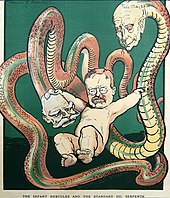
In 1904, Standard controlled 91 percent of production and 85 per centum of final sales. Most of its output was kerosene, of which 55 per centum was exported around the globe. After 1900 information technology did not try to force competitors out of business concern by selling at a loss.[40] The federal Commissioner of Corporations studied Standard's operations from the flow of 1904 to 1906[41] and concluded that "across question ... the dominant position of the Standard Oil Co. in the refining industry was due to unfair practices—to abuse of the control of pipe-lines, to railroad discriminations, and to unfair methods of competition in the sale of the refined petroleum products".[42] Considering of competition from other firms, their market share had gradually eroded to lxx percent by 1906 which was the year when the antitrust case was filed against Standard, and down to 64 percent by 1911 when Standard was ordered cleaved upward[43] and at least 147 refining companies were competing with Standard including Gulf, Texaco, and Shell.[44] It did not endeavour to monopolize the exploration and extraction of oil (its share in 1911 was 11 percent).[ citation needed ]
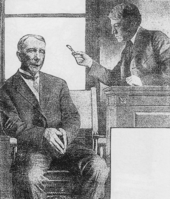
In 1909, the U.Due south. Justice Section sued Standard under federal antitrust law, the Sherman Antitrust Human activity of 1890, for sustaining a monopoly and restraining interstate commerce by:
Rebates, preferences, and other discriminatory practices in favor of the combination past railroad companies; restraint and monopolization by command of pipe lines, and unfair practices against competing pipe lines; contracts with competitors in restraint of trade; unfair methods of competition, such equally local price cutting at the points where necessary to suppress contest; [and] espionage of the business organization of competitors, the operation of bogus independent companies, and payment of rebates on oil, with the like intent.[45]
The lawsuit argued that Standard's monopolistic practices had taken place over the preceding iv years:
The general consequence of the investigation has been to disclose the being of numerous and flagrant discriminations by the railroads in behalf of the Standard Oil Co. and its affiliated corporations. With comparatively few exceptions, mainly of other large concerns in California, the Standard has been the sole beneficiary of such discriminations. In nigh every department of the state that company has been institute to savor some unfair advantages over its competitors, and some of these discriminations affect enormous areas.[46]
The authorities identified four illegal patterns: (1) secret and semi-secret railroad rates; (ii) discriminations in the open arrangement of rates; (three) discriminations in classification and rules of shipment; (4) discriminations in the handling of private tank cars. The authorities alleged:
Almost everywhere the rates from the shipping points used exclusively, or almost exclusively, by the Standard are relatively lower than the rates from the shipping points of its competitors. Rates have been made low to let the Standard into markets, or they have been made high to go on its competitors out of markets. Trifling differences in distances are made an excuse for large differences in rates favorable to the Standard Oil Co., while large differences in distances are ignored where they are against the Standard. Sometimes connecting roads prorate on oil—that is, make through rates which are lower than the combination of local rates; sometimes they reject to prorate; just in either example the result of their policy is to favor the Standard Oil Co. Different methods are used in different places and nether unlike atmospheric condition, but the net result is that from Maine to California the full general organization of open up rates on petroleum oil is such as to give the Standard an unreasonable advantage over its competitors.[47]
The government said that Standard raised prices to its monopolistic customers but lowered them to injure competitors, oftentimes disguising its illegal actions by using bogus supposedly contained companies it controlled.
The evidence is, in fact, absolutely conclusive that the Standard Oil Co. charges altogether excessive prices where it meets no contest, and peculiarly where there is petty likelihood of competitors inbound the field, and that, on the other hand, where contest is active, it often cuts prices to a indicate which leaves even the Standard little or no profit, and which more ofttimes leaves no profit to the competitor, whose costs are ordinarily somewhat higher.[48]
On May 15, 1911, the US Supreme Courtroom upheld the lower court judgment and declared the Standard Oil grouping to be an "unreasonable" monopoly nether the Sherman Antitrust Act, Section II. It ordered Standard to intermission up into 34 independent companies with different boards of directors, the biggest two of the companies were Standard Oil of New Jersey (which became Exxon) and Standard Oil of New York (which became Mobil).[49]
Standard's president, John D. Rockefeller, had long since retired from whatever direction function. Only, equally he owned a quarter of the shares of the resultant companies, and those share values mostly doubled, he emerged from the dissolution equally the richest homo in the world.[fifty] The dissolution had actually propelled Rockefeller's personal wealth.[51]
Breakup [edit]
By 1911, with public outcry at a climax, the Supreme Courtroom of the Us ruled, in Standard Oil Co. of New Jersey v. The states, that Standard Oil of New Jersey must exist dissolved nether the Sherman Antitrust Act and carve up into 34 companies.[52] [53] Two of these companies were Standard Oil of New Jersey (Jersey Standard or Esso), which eventually became Exxon, and Standard Oil of New York (Socony), which eventually became Mobil; those two companies afterward merged into ExxonMobil.
Over the next few decades, both companies grew significantly. Jersey Standard, led by Walter C. Teagle, became the largest oil producer in the globe. It acquired a 50 percent share in Humble Oil & Refining Co., a Texas oil producer. Socony purchased a 45 percent interest in Magnolia Petroleum Co., a major refiner, marketer, and pipeline transporter. In 1931, Socony merged with Vacuum Oil Co., an industry pioneer dating dorsum to 1866, and a growing Standard Oil spin-off in its own correct.[53]
In the Asia-Pacific region, Bailiwick of jersey Standard had oil product and refineries in Indonesia just no marketing network. Socony-Vacuum had Asian marketing outlets supplied remotely from California. In 1933, Jersey Standard and Socony-Vacuum merged their interests in the region into a l–l joint venture. Standard-Vacuum Oil Co., or "Stanvac", operated in 50 countries, from East Africa to New Zealand, before information technology was dissolved in 1962.
Rockefeller's original company, Standard Oil Company of Ohio (Sohio), effectively ceased to exist when it was purchased by BP in 1987.[54] BP continued to sell gasoline nether the Sohio brand until 1991.[54] Other Standard oil entities include "Standard Oil of Indiana" which became Amoco afterward other mergers and a proper name modify in the 1980s, and "Standard Oil of California" which became the Chevron Corp.
Legacy and criticism of breakup [edit]
Some have speculated that if not for that court ruling, Standard Oil could have maybe been worth more than $1 trillion in the 2000s.[55] Whether the breakup of Standard Oil was beneficial is a matter of some controversy.[56] Some economists believe that Standard Oil was not a monopoly, and also argue that the intense free market contest resulted in cheaper oil prices and more than various petroleum products. Critics claimed that success in meeting consumer needs was driving other companies, who were non as successful, out of the market. An instance of this thinking was given in 1890, when Rep. William Mason, arguing in favor of the Sherman Antitrust Act, said: "trusts accept made products cheaper, take reduced prices; but if the price of oil, for instance, were reduced to one cent a butt, it would not correct the incorrect washed to people of this country past the trusts which take destroyed legitimate contest and driven honest men from legitimate business organisation enterprise".[57]
The Sherman Antitrust Act prohibits the restraint of trade. Defenders of Standard Oil insist that the company did non restrain merchandise; they were only superior competitors. The federal courts ruled otherwise.
Some economical historians take observed that Standard Oil was in the process of losing its monopoly at the fourth dimension of its breakup in 1911. Although Standard had 90 percentage of American refining capacity in 1880, past 1911, that had shrunk to between 60 and 65 per centum because of the expansion in capacity by competitors.[58] Numerous regional competitors (such equally Pure Oil in the East, Texaco and Gulf Oil in the Gulf Coast, Cities Service and Sun in the Midcontinent, Union in California, and Beat out overseas) had organized themselves into competitive vertically integrated oil companies, the industry structure pioneered years earlier past Standard itself. In addition, need for petroleum products was increasing more chop-chop than the ability of Standard to expand. The result was that although in 1911 Standard yet controlled virtually production in the older regions of the Appalachian Bowl (78 percent share, down from 92 pct in 1880), Lima-Indiana (90 percent, downward from 95 pct in 1906), and the Illinois Basin (83 percent, down from 100 percent in 1906), its share was much lower in the apace expanding new regions that would dominate U.S. oil product in the 20th century. In 1911, Standard controlled but 44 percentage of product in the Midcontinent, 29 percent in California, and x pct on the Gulf Coast.[59]
Some analysts contend that the breakup was beneficial to consumers in the long run, and no one has e'er proposed that Standard Oil be reassembled in pre-1911 form.[60] ExxonMobil, however, does represent a substantial function of the original company.
Since the breakup of Standard Oil, several companies, such as General Motors and Microsoft, accept come up under antitrust investigation for being inherently too big for market competition; still, nigh of them remained together.[61] [62] [63] The only company since the breakup of Standard Oil that was divided into parts like Standard Oil was AT&T, which later on decades every bit a regulated natural monopoly, was forced to divest itself of the Bell Organization in 1984.[64]
Successor companies [edit]
Standard Oil'due south breakup split the company into 34 separate companies. The successor companies class the core of today'due south US oil industry. (Several of these companies were considered amid the Seven Sisters who dominated the industry worldwide for much of the 20th century.) They include:
- Standard Oil of New Jersey (SONJ) – or Esso (S.O.), or Jersey Standard – merged with Humble Oil to course Exxon, at present part of ExxonMobil. Standard Trust companies Carter Oil, Imperial Oil (Canada), and Standard of Louisiana were kept every bit role of Standard Oil of New Jersey after the breakup.
- Standard Oil of New York – or Socony, merged with Vacuum – renamed Mobil, at present part of ExxonMobil.
- Standard Oil of California – or Socal – renamed Chevron, became ChevronTexaco, only returned to Chevron.
- Standard Oil of Indiana – or Stanolind, renamed Amoco (American Oil Co.) – now part of BP.
- Standard's Atlantic and the independent company Richfield merged to grade Atlantic Richfield Company or ARCO, afterwards became office of BP, after sold to Tesoro Corporation, at present part of Marathon Petroleum and in the process of being partially rebranded as Marathon or Speedway depending on each station ownership. Atlantic operations were spun off and bought past Sunoco.
- Continental Oil Company – or Conoco – later merged with Phillips Petroleum Company to course ConocoPhillips, downstream & midstream operations since spun off to form Phillips 66.
- Standard Oil of Kentucky – or Kyso – was acquired by Standard Oil of California, currently Chevron.
- The Standard Oil Company (Ohio) – or Sohio – the original Standard Oil corporate entity, acquired by BP in 1987.
- The Ohio Oil Co. – or The Ohio – marketed gasoline under the Marathon proper noun. The company's upstream operations are now Marathon Oil while the downstream operations is at present known as Marathon Petroleum, and was often a rival with the in-land Standard spinoff, Sohio.
| Standard Oil Co. Inc The "Seven Sisters", breakup 1911 | |||||||||||||||||||||||||||||||||||||||||||||||||||||||||||||||||||||||||||||||||||||||||||||||||||||||||||||||||||
| The Ohio Oil Company renamed Marathon | Standard Oil of Ohio renamed Sohio | Standard Oil of New Jersey renamed Esso | Standard Oil of New York renamed Mobil | Standard Oil of California renamed Chevron | Standard Oil of Indiana renamed Amoco | Standard Oil of Kentucky | |||||||||||||||||||||||||||||||||||||||||||||||||||||||||||||||||||||||||||||||||||||||||||||||||||||||||||||
| Apprehensive Oil Acq 1959 | Vacuum Oil Company Acq 1931 | Texaco Acq 2000 | Unocal Corporation Acq 2005 | American Oil Visitor Acq 1925 | |||||||||||||||||||||||||||||||||||||||||||||||||||||||||||||||||||||||||||||||||||||||||||||||||||||||||||||||
| Exxon | Mobil | ||||||||||||||||||||||||||||||||||||||||||||||||||||||||||||||||||||||||||||||||||||||||||||||||||||||||||||||||||
| Marathon Petroleum | BP | ExxonMobil | Chevron | ||||||||||||||||||||||||||||||||||||||||||||||||||||||||||||||||||||||||||||||||||||||||||||||||||||||||||||||||
Other companies divested in the 1911 breakup:
- Anglo-American Oil Co. – acquired past Bailiwick of jersey Standard in 1930, now Esso UK.
- Buckeye Pipe Line Co.
- Borne-Scrymser Co. (chemicals)
- Chesebrough Manufacturing (acquired by Unilever)
- Colonial Oil
- Crescent Pipeline Co.
- Cumberland Pipe Line Co. (acquired by Ashland[65])
- Eureka Pipe Line Co.
- Galena-Signal Oil Co.
- Indiana Pipage Line Co.
- National Transit Co.
- New York Transit Co.
- Northern Pipage Line Co.
- Prairie Oil & Gas
- Solar Refining
- Southern Pipe Line Co.
- South Penn Oil Co. – somewhen became Pennzoil, at present function of Shell.
- Southwest Pennsylvania Pipe Line Co.
- Standard Oil of Kansas
- Standard Oil of Nebraska
- Swan and Finch
- Union Tank Lines
- Vacuum Oil Co.
- Washington Oil Co.
- Waters-Pierce
Note: Standard Oil of Colorado was not a successor visitor; the name was used to capitalize on the Standard Oil make in the 1930s. Standard Oil of Connecticut is a fuel oil marketer not related to the Rockefeller companies.
Other Standard Oil spin-offs:
- Standard Oil of Iowa – pre-1911 – bought out by Chevron.
- Standard Oil of Minnesota – pre-1911 – bought out by Amoco.
- Standard Oil of Illinois - pre-1911 - bought out by Amoco.
- Standard Oil of Missouri – pre-1911 – dissolved.
- Standard Oil of Louisiana – originally endemic by Standard Oil of New Bailiwick of jersey (now by Exxon).
- Standard Oil of Brazil – originally owned by Standard Oil of New Jersey (now by Exxon).
Rights to the proper noun [edit]
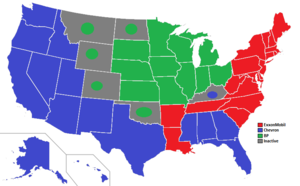
This map shows by country which company has the rights to the Standard Oil name. ExxonMobil has total international rights and continues to use the Esso name overseas. States that are gray have a dot representing their owners, merely are not actively existence used; ExxonMobil operates in all these states and accept de facto claimed the trademark.
Of the 34 "Baby Standards", 11 were given rights to the Standard Oil name, based on the state they were in. Conoco and Atlantic elected to utilize their respective names instead of the Standard name, and their rights would be claimed by other companies.
By the 1980s, most companies were using their brand names instead of the Standard name, with Amoco existence the terminal i to accept widespread apply of the "Standard" proper name, as it gave Midwestern owners the option of using the Amoco proper name or Standard.
Three supermajor companies now ain the rights to the Standard name in the United States: ExxonMobil, Chevron Corp., and BP. BP acquired its rights through acquiring Standard Oil of Ohio and merging with Amoco and has a pocket-sized handful of stations in the Midwestern United States using the Standard name. Likewise, BP continues to sell marine fuel under the Sohio brand at various marinas throughout Ohio. ExxonMobil keeps the Esso trademark live at stations that sell diesel fuel by selling "Esso Diesel" displayed on the pumps. ExxonMobil has full international rights to the Standard name, and continues to use the Esso name overseas and in Canada. To protect its trademark, Chevron has i station in each land it owns the rights to be branded as Standard.[ citation needed ] Some of its Standard-branded stations take a mix of some signs that say Standard and some signs that say Chevron. Over fourth dimension, Chevron has changed which station in a given country is the Standard station.
In February 2016, ExxonMobil successfully asked a U.South. federal court to lift the 1930s, trademark injunction that banned information technology from using the Esso brand in some states. Neither BP nor Chevron objected to the decision. ExxonMobil asked for information technology to exist lifted primarily so it could have universal marketing cloth for its stations globally and, too, the Esso name returned to some minor station signage at both Exxon and Mobil stations.[66] [67]
Equally of 2021, vi states that have the Standard Oil name rights are not being actively used past the companies that ain them. Chevron withdrew from Kentucky (home of the Standard Oil of Kentucky, which Chevron caused in 1961) in 2010, while BP gradually withdrew from v Great Plains and Rocky Mountain states (Colorado, Montana, Due north Dakota, Oklahoma, and Wyoming) since the initial conversion of Amoco sites to BP. As ExxonMobil has stations in all of these states, with the aforementioned minor signage ExxonMobil has de facto claimed the Standard trademark in these states, though they are still held by their respective rights holders.
-

I of xv Chevron stations branded as "Standard" to protect Chevron's trademark; this one is in Las Vegas, Nevada.
-

BP continues to sell marine fuel under the Sohio brand at various marinas on Ohio waterways and in Ohio land parks in order to protect its rights in the Sohio and Standard Oil names. The Anderson Ferry Marina virtually Cincinnati, Ohio is pictured.
-

Station signage at an Exxon station in Columbus, Ohio featuring the Esso logo, while BP owns the rights to the Standard Oil name in Ohio.
Run across also [edit]
- History of the United states of america (1865–1918)
- Standard Oil Gasoline Station (disambiguation)
- Wamsutta Oil Refinery
References [edit]
Citations [edit]
- ^ "John D. and Standard Oil". Bowling Green State University. Archived from the original on May 4, 2008. Retrieved May 7, 2008.
- ^ "Rockefellers Timeline". PBS. Archived from the original on Apr 26, 2008. Retrieved May vii, 2008.
- ^ "Warden Winter Home". Florida Historical Markers. Waymarking.com. Archived from the original on August 7, 2017. Retrieved May 1, 2018.
- ^ "Jacob Vandergrift…Transportation Pioneer - Oil150.com". oil150.com. Archived from the original on March 14, 2012. Retrieved May one, 2018.
- ^ Random Reminiscences of Men and Events by John D. Rockefeller. Archived from the original on May 1, 2018. Retrieved May 1, 2018 – via www.gutenberg.org.
- ^ "Exxon Mobil - Our history". Exxon Mobil Corp. Archived from the original on Nov 12, 2008. Retrieved February iii, 2009.
- ^ Dies, Edward (1969). Behind the Wall Street Curtain. Ayer. p. 76. ISBN9780836911787.
- ^ Grayson, Leslie E. (1987). Who and How in Planning for Large Companies: Generalizations from the Experiences of Oil Companies. p. 213. ISBN9781349084128 . Retrieved June 27, 2017.
- ^ a b Hielscher, Udo. Historische amerikanische Aktien. pp. 68–74. ISBN3921722063.
- ^ Yergin, Daniel (1991). The Prize: The Epic Quest for Oil, Money, and Power. New York: Simon & Schuster. p. 35. ISBN0-671-50248-four.
- ^ Hidy, Ralph W. & Hidy, Muriel East. (1956). History of Standard Oil Co. (New Jersey : Pioneering in Big Business organization 1882–1911). Harper.
- ^ Jones, Eliot (1922). The Trust Problem in the United States. p. 76. .
- ^ Hawke, David Freeman (1980). John D. The Founding Begetter of the Rockefellers. Harper & Row. ISBN978-0060118136.
- ^ King, Gilbert. "The Woman Who Took on the Tycoon". Smithsonian . Retrieved February 6, 2019.
- ^ "Proceedings of the Special Committee on Railroads, Appointed under a resolution of the Assembly to investigate alleged abuses in the Management of Railroads chartered by the State of New York (Vol. I, 1879)". New York State Legislature. 1879. Retrieved Feb eleven, 2022 – via Cyberspace Annal.
Resolved, That a special Commission of v [after increased to nine] persons be appointed, with ability to send for persons and papers, and to use a stenographer, whose duty information technology shall exist to investigate the abuses alleged to exist in the management of the railroads chartered past this Land, and to inquire into and report concerning their powers, contracts and obligations; said Committee to take testimony in the city of New York, and such other places equally they may deem necessary, and to report to the Legislature, either at the present or the adjacent session, past bill or otherwise, what, if any, legislation is necessary to protect and extend the commercial and industrial interests of the State. Composed of Messrs. HEPBURN, HUSTED, DUGUID, Depression, GRADY, NOYES, WADSWORTH, TERRY and Baker, met at the Capitol in the City of Albany on Midweek March 26th, 1879, at iii o'clock P. M., and was called to order by the Chairman.
- ^ Hawke, David Freeman (1980). John D. The Founding Begetter of the Rockefellers. Harper & Row. pp. 145-150. ISBN978-0060118136.
- ^ Whitten, David O. & Whitten, Bessie Emrick (1990). Handbook of American Business organization History: Manufacturing. Greenwood Publishing Group. p. 182.
- ^ "Standard Oil Visitor and Trust | American corporation". Encyclopedia Britannica. Archived from the original on August 25, 2017. Retrieved August 25, 2017.
- ^ Josephson, Matthew (1962). The Robber Barons. Harcourt Trade. ISBN0156767902.
- ^ Armentano, Dominick (1999). Antitrust and Monopoly: Anatomy of a Policy Failure. Oakland, CA: The Contained Found. pp. 64–65.
- ^ Daniels, Eric (Winter 2009). "Antitrust with a Vengeance: The Obama Administration's Anti-Business Cudgel". The Objective Standard. Vol. fourteen, no. 4. Glen Allen Press. pp. 84–85.
- ^ Jones (1922), p. 88.
- ^ Desjardins, Jeff (November 24, 2017). "Nautical chart: The Evolution of Standard Oil".
- ^ Standard Oil controlled past a small group of families—run into Chernow, Ron (1998). Titan: The Life of John D. Rockefeller, Sr. London: Warner Books. p. 291.
- ^ Jones (1922), pp. 89–90.
- ^ Schmidt, Arthur (1997). "Weetman Dickinson Pearson (Lord Cowdray)". Encyclopedia of United mexican states. Vol. 2. Chicago: Fitzroy and Dearborn. p. 1068.
- ^ Crow, Carl (2007). Foreign Devils in the Flowery Kingdom (2d ed.). Hong Kong: Earnshaw Books. ISBN978-988-99633-iii-0. pp. 41–42
- ^ Cochran, S. (2000). Encountering Chinese Networks: Western, Japanese, and Chinese Corporations in People's republic of china, 1880–1937. Academy of California Press. p. 38.
- ^ Anderson, Irvine H. Jr. (1975). The Standard-Vacuum Oil Co. and Us East Asian Policy, 1933–1941. Princeton University Printing. p. xvi.
- ^ Anderson (1975), p. 203.
- ^ The Mei Foo Shield, A monthly publication of the North Red china Department of Standard Oil Co. of New York for its Far Eastern Staff.
- ^ Cochran (2000), p. 31.
- ^ Cochran (2000), p. 32.
- ^ Anderson (1975), p. 106.
- ^ Mender, Peter (2010). Thirty Years a Mariner in the Far Due east 1907–1937, The Memoirs of Peter Mender, a Standard Oil Transport Captain on China's Yangtze River. Bangor, ME: Booklocker.
- ^ The Mei Foo Shield, May 1926, Nov 1927
- ^ Mobil Mariner, May 1958
- ^ DeNovo, John A. (1963). American Interests and Policies in the Middle East: 1900–1939. University of Minnesota Press. pp. 169–175. ISBN9781452909363.
- ^ Yergin (1991), pp. 96–98.
- ^ Jones (1922), pp. 58–59, 64.
- ^ Jones (1922), p. 58.
- ^ Jones (1922), pp. 65–66.
- ^ Rosenbaum, David Ira, ed. (1998). Market place Authorization: How Firms Gain, Hold, or Lose It and the Impact on Economic Performance. Greenwood Publishing Group. p. 33.
- ^ Armentano, Dominick (1999). Antitrust: The Example for Repeal. Ludwig von Mises Institute. p. 57.
- ^ Manns, Leslie D. (1998). "Dominance in the Oil Manufacture: Standard Oil from 1865 to 1911". In Rosenbaum, David I. (ed.). Market Dominance: How Firms Gain, Hold, or Lose information technology and the Touch on Economic Operation. Praeger. p. 11.
- ^ Jones (1922), p. 73.
- ^ Jones (1922), pp. 75–76.
- ^ Jones (1922), p. 80.
- ^ Run into generally Standard Oil Co. of New Jersey v. The states, 221 U.S. ane (1911).
- ^ Rockefeller the richest man later the dissolution of 1911—run across (1991), p. 113 harvp error: no target: CITEREF1991 (assistance).
- ^ "Standard ogre". The Economist. December 23, 1999. Archived from the original on September 30, 2017. Retrieved March 24, 2018.
- ^ "The Sherman Antitrust Human action and Standard Oil" (PDF). Academy of Houston. January 9, 2014. Archived (PDF) from the original on January 9, 2014.
- ^ a b "A Guide to the ExxonMobil Historical Drove". Academy of Texas at Austin. Archived from the original on January 9, 2014. Retrieved January nine, 2014.
- ^ a b "Standard Oil Company - Ohio History Central". world wide web.ohiohistorycentral.org. Archived from the original on August 25, 2017. Retrieved Baronial 25, 2017.
- ^ CFA, Jim Fink (December three, 2007). "The Investing Secrets of the Richest Man the World Has Always Known". fool.com. Archived from the original on December 1, 2017. Retrieved May one, 2018.
- ^ Wanniski, Jude (June 12, 1998). "Antitrust, past Alan Greenspan". Polyconomics. Archived from the original on December 17, 2005. Retrieved December 17, 2005.
- ^ Congressional Tape, 51st Congress, 1st session, House, June xx, 1890, p. 4100.
- ^ Yergin (1991), p. 79.
- ^ Williamson, Harold F.; et al. (1963). The American Petroleum Industry, 1899–1959. Evanston, Illinois: Northwestern Academy Printing. p. 4-14.
- ^ Rosenbaum, David I., ed. (1998). Marketplace Dominance: How Firms Proceeds, Hold, or Lose it and the Impact on Economic Performance. New York: Praeger. pp. 31–33.
- ^ "Microsoft striking by record Eu fine". CNN. March 25, 2004. Archived from the original on Apr 13, 2006. Retrieved August fourteen, 2010.
- ^ "Commission Determination of 24.03.2004 relating to a proceeding nether Article 82 of the EC Treaty (Instance COMP/C-iii/37.792 Microsoft)" (PDF). Commission of the European Communities. April 21, 2004. Retrieved August 5, 2005.
- ^ First, Harry & Carstensen, Peter (June 19, 2009). "As well Big and Failing: The Missed Chance to Break Up GM". Viewpoint. Bloomberg Businessweek. Archived from the original on September fourteen, 2014. Retrieved November 22, 2013.
- ^ Pollack, Andrew (September 22, 1995). "AT&T Move Is a Reversal Of Grade Set in 1980'south". The New York Times. Archived from the original on November 19, 2016.
- ^ "Ashland Oil & Refining Visitor - Lehman Brothers Collection". Archived from the original on December 8, 2015. Retrieved December 1, 2015.
- ^ "The Render of Esso Gasoline?". Law360. February 16, 2016. Retrieved September 18, 2016.
- ^ "Subsequently 78 Years, Exxon Asks Courtroom To Use 'Esso' Proper noun Again". Law360. December 21, 2015. Retrieved September 18, 2016.
Full general bibliography [edit]
- Bringhurst, Bruce (1979). Antitrust and the Oil Monopoly: The Standard Oil Cases, 1890–1911. New York: Greenwood Press.
- Giddens, Paul H. (1976). Standard Oil Co. (Companies and men). New York: Ayer Co. Publishing.
- Henderson, Wayne (1996). Standard Oil: The First 125 Years. New York: Motorbooks International.
- Knowlton, Evelyn H. & Gibb, George S. (1956). History of Standard Oil Co.: Resurgent Years 1911–1927. New York: Harper & Row.
- Lamoreaux, Naomi R. (2019). "The Trouble of Bigness: From Standard Oil to Google". Periodical of Economic Perspectives. Vol. 33, no. 3. pp. 94–117.
- Latham, Earl, ed. (1949). John D. Rockefeller: Robber Baron or Industrial Statesman?.
- Montague, Gilbert The netherlands (1902). The Rise And Progress of the Standard Oil Co.
- ——— (February 1902). "The Ascent and Supremacy of the Standard Oil Co". Quarterly Journal of Economic science. Vol. xvi, no. 2. pp. 265–292. JSTOR 1882746.
- ——— (Feb 1903). "The Subsequently History of the Standard Oil Co". Quarterly Periodical of Economics. Vol. 17, no. 2. pp. 293–325. JSTOR 1883667.
- Nevins, Allan (1940). John D. Rockefeller: The Heroic Age of American Enterprise.
- Nowell, Gregory P. (1994). Mercantile States and the World Oil Dare, 1900–1939 . Cornell University Press. ISBN9780801428784.
- Tarbell, Ida M. (1904). The History of the Standard Oil Co. Archived from the original on February 20, 2004.
- Williamson, Harold F. & Daum, Arnold R. (1959). The American Petroleum Industry: The Age of Illumination, 1859–1899. Vol. 1.
- ——— & ——— (1964). American Petroleum Industry: the Age of Energy 1899–1959. Vol. 2.
External links [edit]
- The Dismantling of The Standard Oil Trust
- The History of the Standard Oil Co. by Ida Tarbell
- Educate Yourself: Standard Oil—Part I
- Witch-hunting for Robber Barons: The Standard Oil Story by Lawrence Due west. Reed—argues Standard Oil was not a coercive monopoly.
- The Truth Most the "Robber Barons"—arguing that Standard Oil was not a monopoly.
- Dynastic America and Those Who Own It, 2003 [1921], by Henry H. Klein
- Standard Oil Trust original Stock Document signed past John. D. Rockefeller, William Rockefeller, Henry M. Flagler and Jabez Abel Bostwick - 1882 Archived September 12, 2018, at the Wayback Motorcar CHARLES A. WHITESHOT: THE OIL-WELL DRILLER. A HISTORY OF THE WORLD'South GREATEST ENTERPRISE, THE OIL INDUSTRY. Publisher: MANNINGTON, 1905
- The Standard Oil (New Bailiwick of jersey) Drove—A digital drove of photographs from the documentary project directed by Roy E. Stryker.
Source: https://en.wikipedia.org/wiki/Standard_Oil
0 Response to "What Did John D. Rockefeller Do to Establish Standard Oil as a Monopoly?"
Post a Comment